
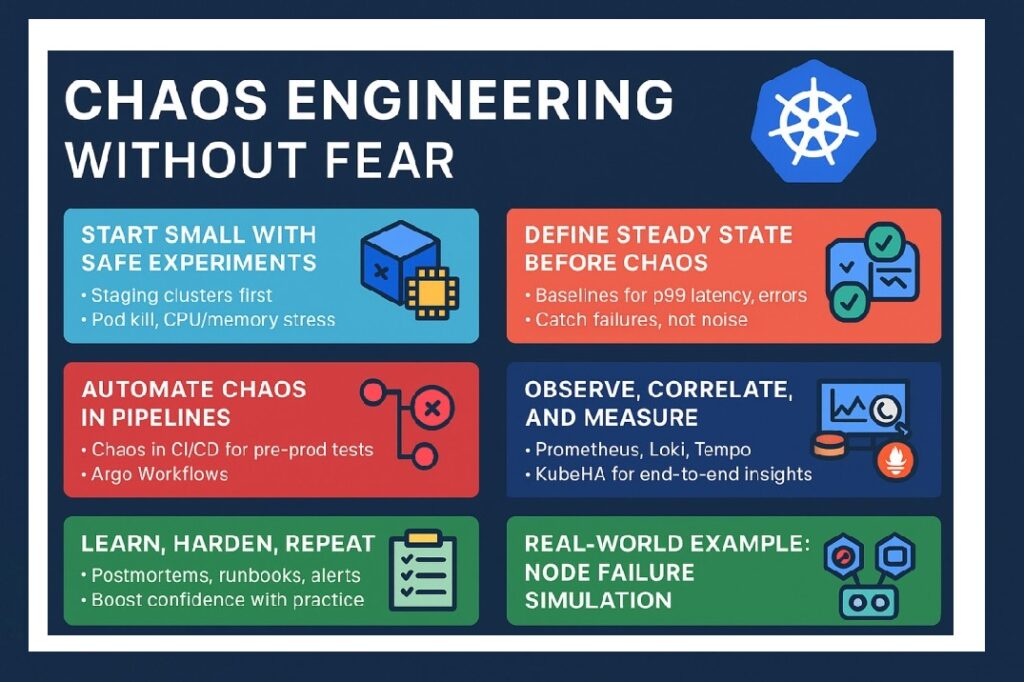
Resilience isn’t proven by uptime – it’s proven by failure. Chaos Engineering is about injecting controlled failures into systems to uncover weaknesses before real outages happen. Done right, it’s not reckless – it’s a scientific way to harden Kubernetes clusters.
1. Start Small with Safe Experiments
- Always begin in staging clusters before production.
- Early experiments: Kill a pod (kubectl delete pod) Add CPU/memory stress Simulate network latency
- Tools: LitmusChaos, Chaos Mesh, Gremlin
Example (pod kill with LitmusChaos):apiVersion: litmuschaos.io/v1alpha1kind: ChaosEnginemetadata: name: pod-killspec: experiments: - name: pod-delete spec: components: env: - name: TARGET_PODS value: "frontend-service"2. Define Steady State Before Chaos
- A chaos experiment is meaningless without a baseline.
- Examples of steady state: p99 latency < 500ms error rate < 1% 95% pod readiness
If chaos pushes metrics beyond these thresholds → your system failed the test.
3. Automate Chaos in Pipelines
- Chaos should not be manual “game days” only.
- Integrate into CI/CD pipelines for pre-production testing.
- Example: run pod-kill in staging as part of Argo Workflows.
This ensures resilience testing happens with every release.
4. Observe, Correlate, and Measure
During chaos, visibility is everything:
- Prometheus → CPU, latency, error rates.
- Loki → Pod crash logs.
- Tempo/Jaeger → Trace bottlenecks in service calls.
- KubeHA → Correlates all signals into root cause + remediation.
Without correlation, chaos just looks like noise.
5. Learn, Harden, Repeat
- Always follow with a blameless postmortem.
- Update runbooks, alerts, and autoscaling configs.
- Over time, chaos should become a confidence booster, not a fire drill.
6. Real-World Example: Node Failure Simulation
- Chaos Mesh simulates node shutdown.
- Prometheus shows pods rescheduled to other nodes.
- Loki logs confirm app-level retries succeeded.
- Steady-state SLA (p99 latency < 500ms) maintained.
 Result: Verified that cluster auto-scaling + retry logic work under failure.
 Bottom Line: Chaos Engineering is not about breaking production – it’s about proving resilience with science. By starting small, defining steady states, automating experiments, and learning from outcomes, DevOps and SRE teams build systems that recover, not just run.
Follow KubeHA for ready-to-use chaos workflows, YAML templates, and AI-powered RCA that make chaos safe, measurable, and fear-free.
Experience KubeHA today: www.KubeHA.com
KubeHA’s introduction, https://www.youtube.com/watch?v=PyzTQPLGaD0