Most SRE Dashboards Are Useless During Incidents.

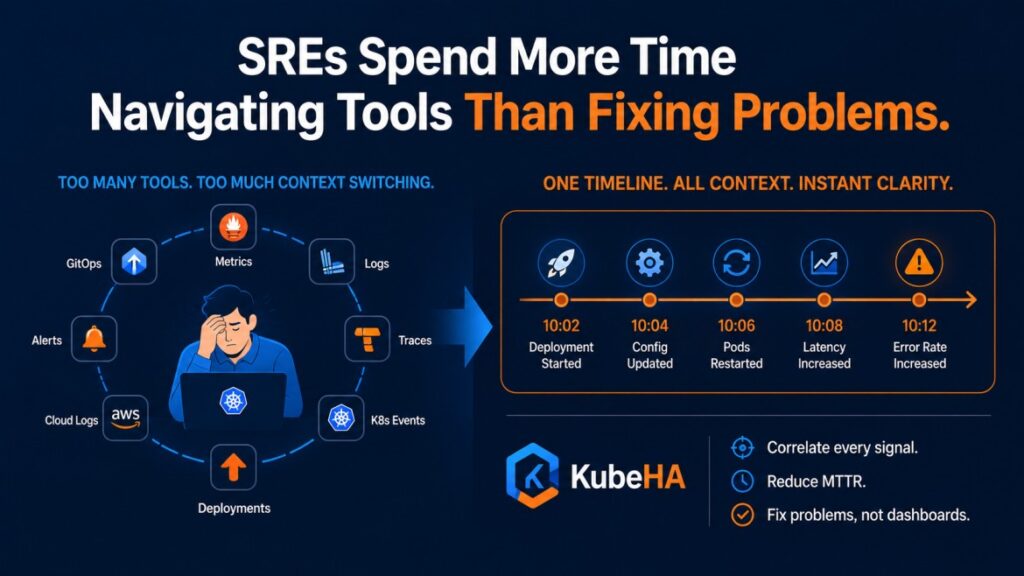
This might sound harsh, but many SREs will agree. During an incident, nobody is calmly staring at dashboards. Engineers are usually running: kubectl logskubectl describekubectl get events   Why? Because dashboards mostly show metrics, not context. A typical dashboard tells you: CPU usage Memory usage Request rate   But incidents require answers like: • What

Most SRE Dashboards Are Useless During Incidents. Read More »

Most Kubernetes Clusters Are Over-Engineered

This may sound controversial, but many production Kubernetes environments today are over-engineered for the problems they actually solve. In many organizations, the platform stack ends up looking like this: • Kubernetes• Service Mesh (Istio / Linkerd)• GitOps (ArgoCD / Flux)• Multiple observability tools• Security scanners• Admission controllers• Policy engines• Custom operators• Complex CI/CD pipelines All

Most Kubernetes Clusters Are Over-Engineered Read More »

CrashLoopBackOff Is Not the Root Cause. It’s a Signal

CrashLoopBackOff Is Not the Root Cause. It’s a Signal. Many engineers see this and panic: CrashLoopBackOff They immediately start checking: Pod logs Application errors Container startup scripts But here’s the reality most people miss: CrashLoopBackOff is not the problem.It’s Kubernetes telling you something deeper is wrong. What CrashLoopBackOff Actually Means When a container repeatedly crashes,

CrashLoopBackOff Is Not the Root Cause. It’s a Signal Read More »

DNS Is the Silent Kubernetes Bottleneck No One Talks About.

When latency spikes,everyone looks at CPU. Very few check DNS. Here’s what happens in real production clusters: • High service-to-service calls• Each call does DNS resolution• CoreDNS under-provisioned• ndots setting causes repeated lookups• DNS retries multiply latency Suddenly:A 20ms call becomes 200ms. But no CPU spike.No memory pressure. Just slow performance. Symptoms:🔸 Random latency spikes🔸

DNS Is the Silent Kubernetes Bottleneck No One Talks About. Read More »

The Most Expensive Kubernetes Mistake: Memory Limits

Most Kubernetes clusters are silently bleeding money. Not because of traffic.Not because of scaling.Not because of bad code. But because of memory limits misconfiguration. This is one of the most common and costly mistakes in production Kubernetes environments. And most teams don’t even realize it. Part 1: The Memory Limits Illusion When teams deploy workloads,

The Most Expensive Kubernetes Mistake: Memory Limits Read More »

0% Error Rate Does NOT Mean Your System Is Healthy.

This one surprises many teams. You open your dashboard: ✅ Error rate: 0%✅ Pods running✅ CPU normal But users are complaining. Why? Because modern systems hide failure in subtle ways: • Retries mask errors• Circuit breakers absorb failures• Timeouts escalate silently• Tail latency (p95 / p99) explodes• Downstream dependencies degrade slowly• Traffic volume drops silently

0% Error Rate Does NOT Mean Your System Is Healthy. Read More »

Your Kubernetes HPA Is Scaling Too Late – And You Don’t Even Know It.

Everyone thinks HPA solves traffic spikes. It doesn’t. Here’s the uncomfortable truth: Kubernetes HPA is reactive, not predictive. By the time CPU hits 80%: Your latency is already rising Your p95 is exploding Queues are forming Users are feeling it Why? Because HPA:• Works on averaged metrics• Depends on scrape intervals• Responds after saturation begins•

Your Kubernetes HPA Is Scaling Too Late – And You Don’t Even Know It. Read More »

Kubernetes 1.35: The SRE Upgrade You Can’t Ignore

In the rapidly evolving world of cloud-native infrastructure, Kubernetes releases a new minor version roughly every four months – and keeping up isn’t a luxury, it’s a necessity. The current recommended production version as of early 2026 is Kubernetes v1.35 (latest patch v1.35.1), which represents the most recent stable and supported release. This is more

Kubernetes 1.35: The SRE Upgrade You Can’t Ignore Read More »

Serverless vs Kubernetes in 2026: What DevOps Leaders Need to Know

Serverless vs Kubernetes in 2026: What DevOps Leaders Need to KnowThe debate isn’t about popularity.It’s about scale behavior, visibility, and long-term control. Serverless Strengths• Auto-scaling by default• Pay-per-execution billing• Low ops overhead• Ideal for spiky, event-driven workloadsChallenge:Cost unpredictability at high throughput, limited runtime control, vendor lock-in risks. Kubernetes Strengths• Full control over runtime & scaling•

Serverless vs Kubernetes in 2026: What DevOps Leaders Need to Know Read More »

Kubernetes Debugging: Then vs Now vs Intelligent

Kubernetes Debugging: Then vs Now vs IntelligentDebugging Kubernetes issues has evolved. But has it evolved enough?Let’s compare Manual (Traditional) Debugging• kubectl describe pod • kubectl logs -f • Check events • SSH into nodes • Grep logs • Reproduce issue Time to RCA: 30 mins – hours Risk: Human error, tunnel vision Depends heavily on

Kubernetes Debugging: Then vs Now vs Intelligent Read More »

How many tabs do you open to understand one production issue?

From CI to Impact – All in One Pane.How many tabs do you open to understand one production issue?• CI Changes• CD Deployments• Config Modifications• Alerts• Impacted Services• Throughput Drops• Error Rate Spikes• Latency ChangesNow imagine seeing all of this in a single pane of glass. KubeHA connects the dots between code → deploy →

How many tabs do you open to understand one production issue? Read More »

Scroll to Top