
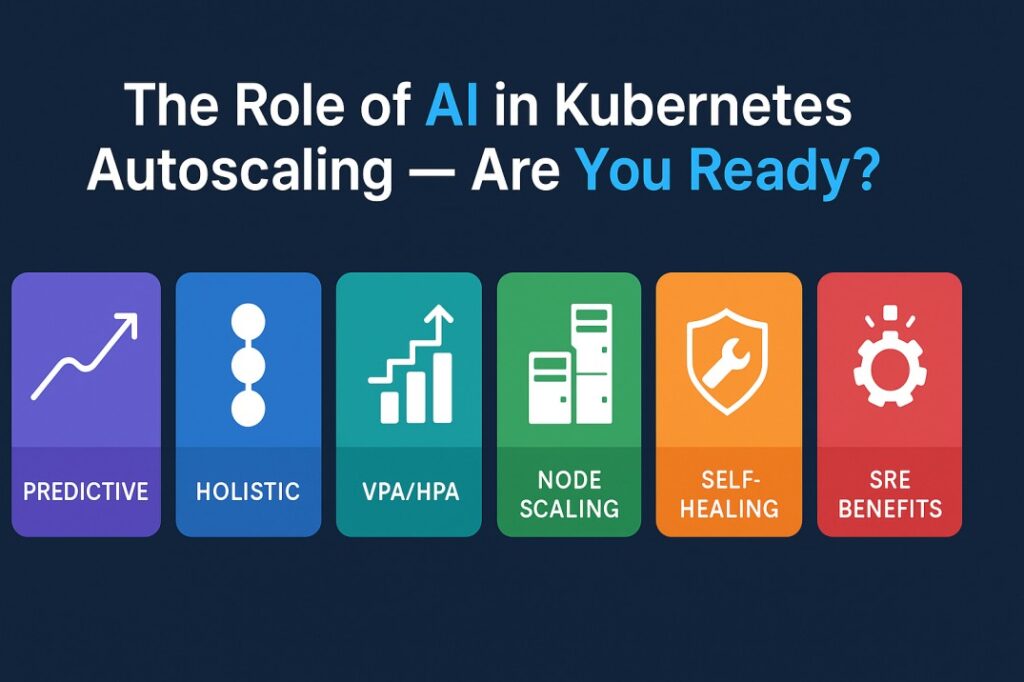
The Role of AI in Kubernetes Autoscaling – Are You Ready?
Kubernetes autoscaling has come a long way – from simple CPU-based thresholds to advanced multi-metric scaling. But in 2025, one thing is clear:
 Static autoscaling rules can’t keep up with today’s unpredictable workloads. AI-driven autoscaling is becoming the new SRE superpower.
Here’s what’s changing – and why it matters.
 The Future: AI-Powered Autoscaling
AI doesn’t replace HPA/VPA – it augments them by learning patterns, predicting demand, and taking smarter decisions before humans even notice issues.
1️ Predictive Scaling – Not Reactive
Traditional autoscaling waits for spikes.
AI looks at:
- Traffic prediction models
- Historical demand curves
- Seasonality (weekday/weekend, time of day)
- Application behavior under load
Result: Scale before the spike hits.
2️ Holistic Metrics – Beyond CPU/RAM
Kubernetes HPA is reactive and narrow.
AI evaluates multi-dimensional signals:
- Request latency
- Queue lengths
- Error rate acceleration
- GC pressure
- Pod startup delay
- Node saturation
- Cost efficiency
This means scaling decisions align with SLOs – not raw resource usage.
3️ Intelligent VPA + HPA Coordination
Manual VPA tuning = risky.
AI systems can:
- Detect over-provisioned pods
- Identify memory leak patterns
- Suggest safe requests/limits
- Adjust threshold triggers dynamically
No more fighting between HPA and VPA.
4️ AI-Assisted Node Autoscaling (Cluster Autoscaler+)
AI predicts when nodes will saturate and pre-warm capacity.
It also:
- Chooses cheapest node pools
- Detects noisy neighbors
- Predicts bin-packing failures
- Suggests optimal pod placement
This saves 30–60% cloud cost in large clusters.
5️ Incident Prevention & Self-Healing
AI can detect early signs of autoscaling failures:
- Pods stuck Pending due to wrong requests
- Scale events causing cascading failures
- Slow-starting containers harming SLOs
- Cost spikes due to runaway scaling loops
And automatically trigger remediation – within seconds.
 Why SREs Should Care
AI-powered autoscaling improves:
- SLO compliance
- Cost optimization
- Burst readiness
- Pod scheduling reliability
- Operational stability
In a world of unpredictable workloads and microservices sprawl, this is no longer optional – it’s the new baseline for high-performing SRE teams.
 Want more?
Follow KubeHA for weekly insights on:
- Kubernetes architecture
- SRE playbooks
- AI-powered operations
- Cloud cost governance
- Real-world platform engineering patterns
KubeHA’s introduction, https://www.youtube.com/watch?v=PyzTQPLGaD0