
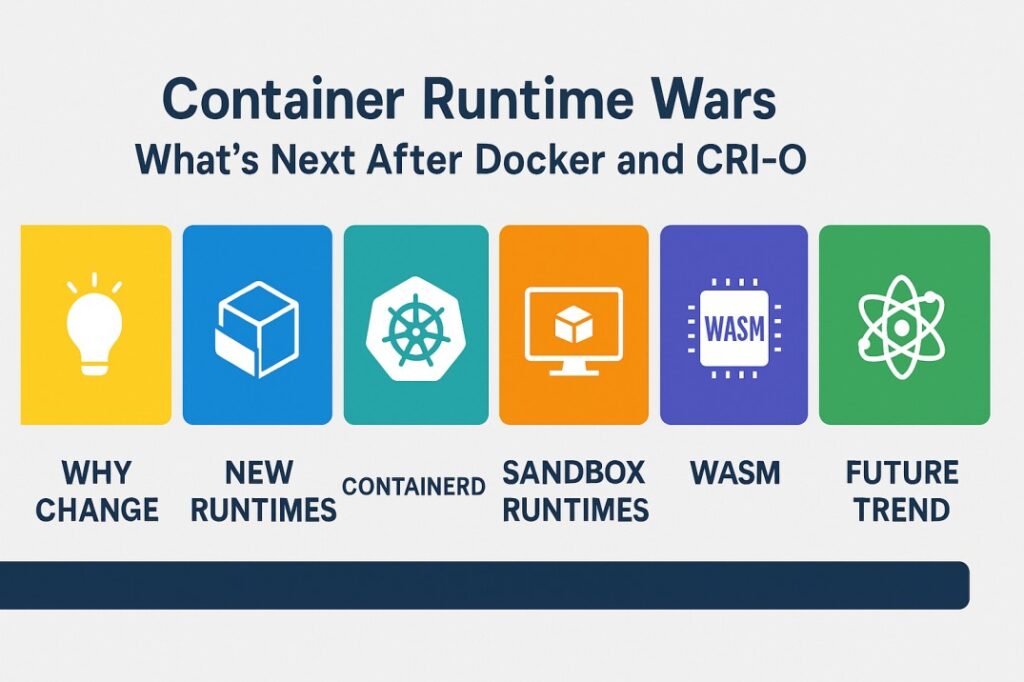
The container runtime landscape is shifting fast.
Docker and CRI-O dominated the last decade – but 2025 marks a turning point.
SREs, Platform Engineers, and Kubernetes Operators are asking:
 What comes after Docker? After CRI-O? What will power the next-generation Kubernetes clusters?
Here’s what’s driving the evolution – and what’s coming.
1️⃣ Why Runtimes Are Changing
Today’s workloads need:
- Lower latency
- Higher density
- Better isolation
- Faster cold starts
- Reduced attack surface
- Multi-cloud portability
- Support for WASM and sandboxed workloads
Traditional container runtimes no longer keep up.
2️⃣ runc → Youki/WASM Shifting the Landscape
 runc
runc
Still the default, but:
- Heavy isolation
- Slow cold starts
- Not ideal for high-density platforms
Youki (Rust-based OCI runtime)
- Faster startup
- Lower memory footprint
- Written in Rust → safer by design
- Quickly becoming preferred in security-sensitive clusters
WebAssembly (WASM) Runtimes (Wasmtime, WasmEdge)
- Near-instant startup
- Extreme portability
- No container required
- Perfect for edge, serverless, and ML inference
WASM adoption is accelerating – it may replace containers for certain workloads.
3️⃣ containerd Taking Over as the New Default
containerd is now the de facto production runtime for Kubernetes:
- Simpler than Docker
- CRI-compliant
- Optimized for K8s
- Supports plugins, snapshotters, and WASM integrations
- Better performance under node pressure
Major clouds use it by default (EKS, GKE, AKS).
4️⃣ Sandbox Runtimes Rising (Isolation becomes mandatory)
gVisor
- Syscall-level sandbox
- Strong isolation
- Minimal overhead
Kata Containers
- MicroVM isolation
- Each pod gets its own kernel
- Used in financial/regulated workloads
These runtimes boost multi-tenant security without killing performance.
5️⃣ eBPF-Driven Runtimes (Future Trend)
eBPF-based runtime assistants will offer:
- Zero-overhead security checks
- Kernel-level introspection
- Dynamic syscall filtering
- Real-time container profiling
Tools like Cilium, Tetragon, and Pixie hint at what’s coming.
eBPF may become the invisible runtime layer behind all container engines.
6️⃣ What SREs Should Prepare For
WASM-native services Hybrid runtimes per workload type MicroVM-backed pods eBPF observability baked into runtimes containerd everywhere Rust-based secure runtimes (Youki) Fewer “containers”, more sandboxed executions
The runtime ecosystem is diversifying, not consolidating.
 Bottom Line
Docker and CRI-O were just the beginning.
The future of container execution is faster, safer, lighter, and more modular.
The next wave includes:
- containerd as the standard
- Rust-based runtimes (Youki)
- MicroVM workloads (Kata/gVisor)
- WASM for ultra-fast applications
- eBPF-driven security runtimes
Kubernetes will soon run workloads matched to the best runtime-not a one-size-fits-all container engine.
Follow KubeHA
For insights on:
- Kubernetes security evolution
- WASM adoption
- Runtime performance benchmarking
- eBPF observability
- Multi-cloud platform engineering
- SRE automation best practices
KubeHA’s introduction, https://www.youtube.com/watch?v=PyzTQPLGaD0