
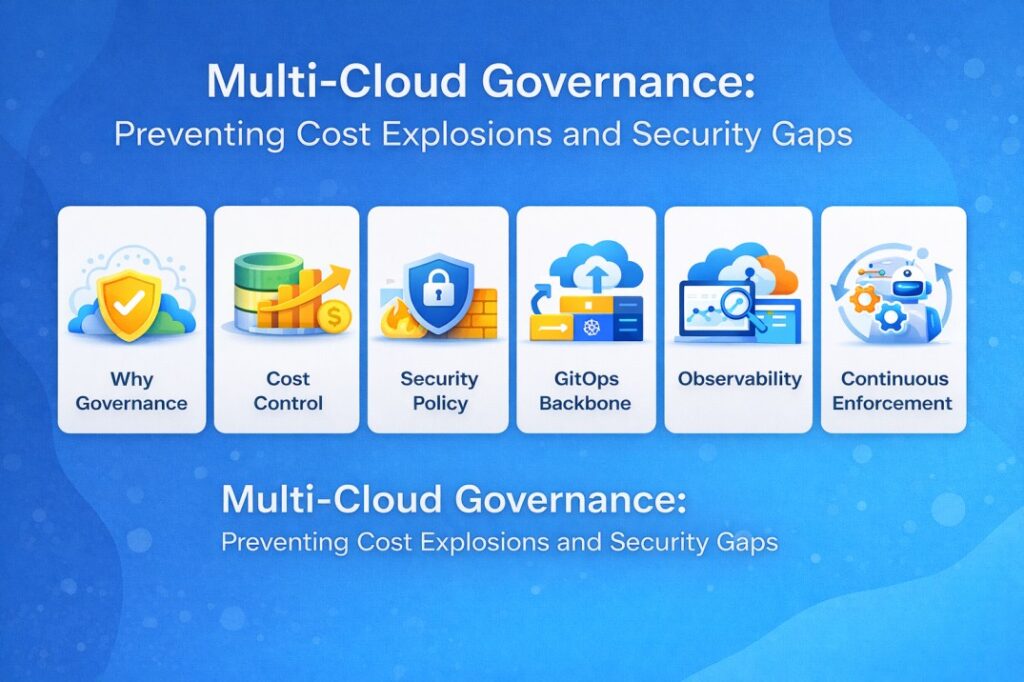
Multi-cloud promises flexibility and vendor independence – but without governance, it quickly turns into uncontrolled cost growth and security blind spots.
In 2025, most production outages and cloud bill shocks don’t come from outages – they come from governance failure.
Here’s how modern SRE and Platform teams tackle it.
1. Why Multi-Cloud Breaks Without Governance
Once workloads span AWS, Azure, GCP, and on-prem:
- Cost visibility fragments across billing systems
- IAM models diverge (IAM, Azure AD, GCP IAM)
- Network policies differ per cloud
- Security controls drift silently
- Teams over-provision “just in case”
The result: cost explosions + inconsistent security posture.
2. Cost Governance: From Reactive to Predictive
Modern governance goes beyond cost reports.
Key controls:
- Standardized labels/tags (team, env, app, cost_center)
- Budgets enforced as policy, not emails
- Right-sizing automation using metrics (CPU, memory, request rates)
- Idle resource detection across clusters and clouds
- Pre-deployment cost estimation via IaC pipelines
SREs now treat cost as an SLO-adjacent metric.
3. Security Governance at Scale
Security gaps emerge when:
- RBAC differs per cluster
- NetworkPolicies are inconsistent
- Admission rules vary between clouds
- Secrets are managed per-provider
The fix:
- Policy as Code (OPA / Kyverno)
- Zero-Trust networking defaults
- Consistent admission controls across clusters
- Central identity federation
- Audit-ready enforcement, not manual review
Same rules. Every cloud.
4. GitOps as the Governance Backbone
GitOps is no longer optional in multi-cloud:
- Git becomes the authoritative control plane
- Drift detection prevents manual changes
- Rollbacks are deterministic
- Governance rules travel with code
If it’s not in Git, it’s not governed.
5. Observability-Driven Governance
Metrics tell the truth governance reports miss:
- Unused capacity
- Sudden cost spikes
- Insecure traffic patterns
- Scaling anomalies
- Policy violations under load
Platforms like KubeHA correlate:
- Cost signals
- Security posture
- Runtime behavior
Governance becomes continuous, not quarterly.
6. What Winning Teams Do in 2025
 Enforce cost & security via code Centralize governance logic Automate audits Prevent drift Treat cloud spend as reliability risk
 Bottom Line
Multi-cloud doesn’t fail because it’s complex.
It fails because governance doesn’t scale manually.
The future belongs to teams that enforce:
Cost + Security + Reliability – by design, by code, by automation.
 Follow KubeHA for:
- Multi-cloud governance blueprints
- Cost-aware SRE practices
- Kubernetes security automation
- Policy-driven operations
- AI-assisted cloud optimization
Experience KubeHA today: www.KubeHA.com
KubeHA’s introduction, https://www.youtube.com/watch?v=PyzTQPLGaD0