
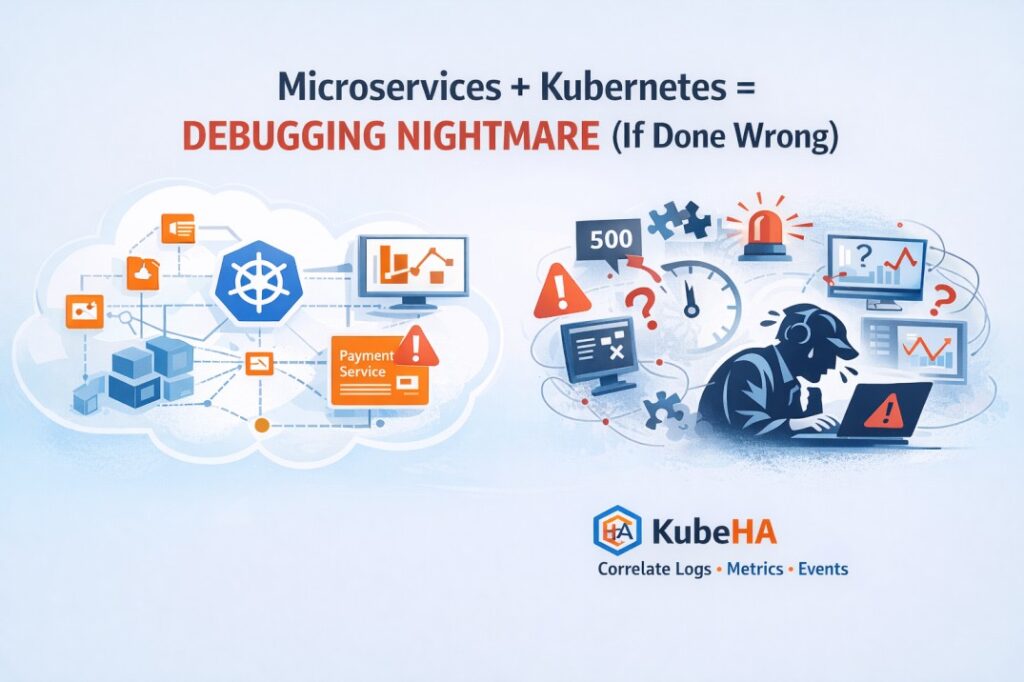
Microservices promised scalability, flexibility, and independent deployments.
Kubernetes made it possible to run them at scale.
But together, they introduced a new problem:
Debugging distributed systems is exponentially harder than building them.
Why Debugging Becomes a Nightmare
In a monolith:
• one codebase
• one runtime
• one log stream
• one failure domain
In microservices on Kubernetes:
• dozens (or hundreds) of services
• multiple replicas per service
• dynamic scheduling across nodes
• network-based communication
• independent deployments
A single user request may traverse:
API Gateway → Auth Service → Payment Service → Inventory Service → Database
A failure at any point can manifest somewhere else.
The Core Problem: Failure Propagation
Most engineers debug where the error appears.
But in distributed systems:
The place where the error appears is rarely where it originates.
Example:
• API returns 500
• logs show timeout in payment-service
Actual root cause:
• DNS latency spike
• node CPU throttling
• connection pool exhaustion
• retry storm from another service
Failures propagate across services and layers.
Kubernetes Makes It More Dynamic
Kubernetes introduces additional complexity:
1. Ephemeral Infrastructure
Pods restart.
IPs change.
Containers get rescheduled.
Debugging becomes time-sensitive because:
• logs disappear
• state is transient
• behavior shifts quickly
2. Multiple Failure Layers
Layer | Example Issue |
Application | exception, timeout |
Container | OOMKilled |
Pod | CrashLoopBackOff |
Node | CPU throttling |
Network | DNS latency |
Cluster | scheduling delay |
Microservices + Kubernetes = failures across multiple layers simultaneously.
3. Observability Fragmentation
Most teams have:
• logs in one tool
• metrics in another
• traces (sometimes)
• events rarely used
Debugging becomes:
kubectl logs → Prometheus → Grafana → kubectl describe → back to logs
This context switching slows down root cause analysis.
Real Incident Scenario
Let’s take a real-world pattern:
Symptom:
• increased latency in checkout service
Observed:
• payment-service timeout errors
What most engineers do:
→ check payment-service logs
What actually happened:
• deployment changed connection pool size
• retry logic increased request volume
• database connections exhausted
• latency increased across services
Without correlation, this takes 30–60 minutes to diagnose.
Why Traditional Debugging Fails
Traditional debugging assumes:
• linear request flow
• single point of failure
• static infrastructure
None of these are true in Kubernetes microservices.
This leads to:
• chasing symptoms instead of root cause
• incorrect remediation (restarts, scaling)
• prolonged incidents
What Effective Debugging Requires
Modern SRE debugging requires:
 Cross-Service Correlation
Understanding how requests flow across services
 Timeline Awareness
What changed before the incident?
 Multi-Signal Visibility
Combining:
• logs
• metrics
• traces
• events
 Dependency Understanding
Which service depends on what?
How KubeHA Helps
KubeHA is designed specifically for this problem.
Instead of forcing engineers to manually connect signals, it does the correlation automatically.
End-to-End Correlation
KubeHA links:
• logs
• metrics
• Kubernetes events
• deployment changes
• pod restarts
into a single investigation flow.
Change-to-Impact Analysis
Example insight:
“Latency increased after deployment v3.4 in payment-service. Retry rate increased 2x. Database connections saturated.”
This immediately highlights:
• what changed
• where impact started
• how it propagated
Root Cause Focus
Instead of:
 “Pod is failing”
You get:
 “Pod restarted due to memory spike after config change in dependency service.”
 Faster Incident Resolution
By reducing guesswork, KubeHA helps:
• reduce MTTR
• avoid unnecessary scaling/restarts
• focus on real root cause
Real Outcome for Teams
Teams that adopt correlation-driven debugging see:
• faster debugging (minutes instead of hours)
• fewer false fixes
• better system understanding
• improved reliability
Final Thought
Microservices + Kubernetes is powerful.
But without proper observability and correlation:
It turns debugging into chaos.
The goal is not just to run distributed systems.
It’s to understand them when they fail.
 To learn more about debugging microservices in Kubernetes, distributed system observability, and incident analysis, follow KubeHA(https://linkedin.com/showcase/kubeha-ara/).
Book a demo today at https://kubeha.com/schedule-a-meet/
Experience KubeHA today: www.KubeHA.com
KubeHA’s introduction, https://www.youtube.com/watch?v=PyzTQPLGaD0
#DevOps #sre #monitoring #observability #remediation #Automation #kubeha #IncidentResponse #AlertRecovery #prometheus #opentelemetry #grafana, #loki #tempo #trivy #slack #Efficiency #ITOps #SaaS #ContinuousImprovement #Kubernetes #TechInnovation #StreamlineOperations #ReducedDowntime #Reliability #ScriptingFreedom #MultiPlatform #SystemAvailability #srexperts23 #sredevops #DevOpsAutomation #EfficientOps #OptimizePerformance #Logs #Metrics #Traces #ZeroCode