
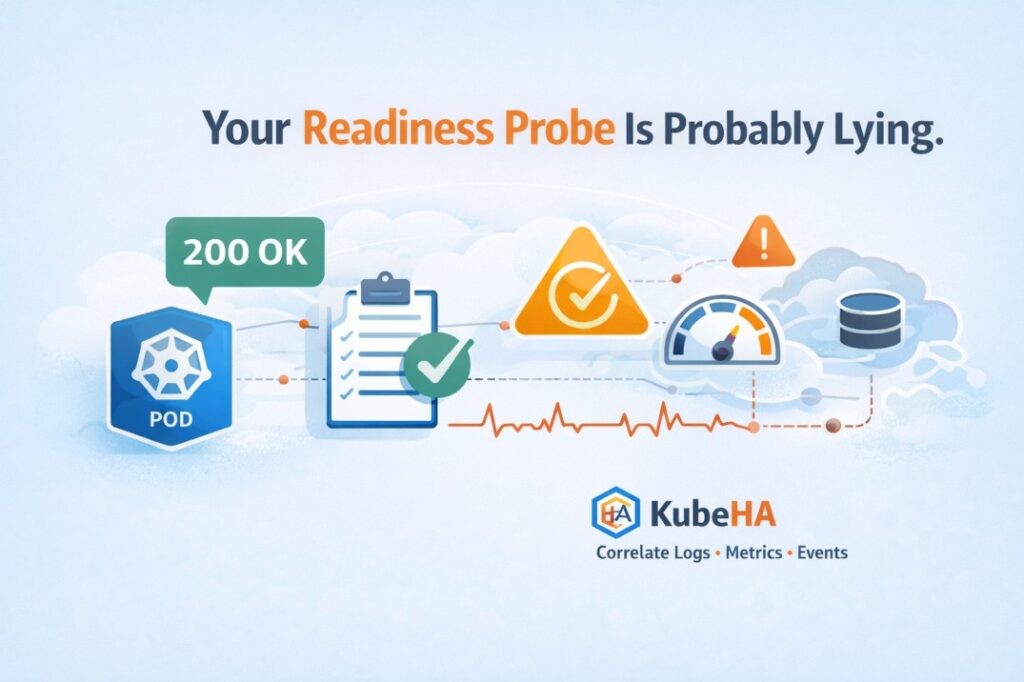
Kubernetes readiness probes are supposed to answer one simple question:
“Can this pod handle traffic?”
In practice, they often answer a very different one:
“Is this process responding to HTTP?”
And that difference causes real production incidents.
What Readiness Probes Actually Do
A typical readiness probe looks like this:
readinessProbe:
httpGet:
path: /health
port: 8080
initialDelaySeconds: 5
periodSeconds: 10
If /health returns 200 OK, Kubernetes marks the pod as Ready.
Traffic starts flowing.
But this assumes:
• dependencies are healthy
• connections are available
• resources are sufficient
• internal state is stable
None of these are guaranteed.
The False Positive Problem
Most readiness endpoints check only:
• application process is running
• HTTP server responds
But production readiness depends on:
• database connectivity
• cache availability
• downstream service latency
• thread pool availability
• connection pool saturation
So you get a situation like:
/readiness → 200 OK
real system → degraded or failing
This creates false confidence in system health.
Real Incident Pattern
Symptom:
• intermittent 500 errors
• increased latency
Kubernetes view:
• all pods are Ready
• no restarts
• no alerts
Reality:
• DB connection pool exhausted
• service returns 200 for health check
• actual requests fail under load
Traffic keeps routing to unhealthy pods because readiness probe says everything is fine.
Why This Happens in Kubernetes
1. Health Endpoints Are Oversimplified
Most teams implement:
return “OK”;
This ignores real system dependencies.
2. Dependency Checks Are Avoided
Teams avoid checking dependencies in readiness probes because:
• it adds latency
• it can cause flapping
• it increases complexity
So probes become superficial.
3. No Context of System Behavior
Readiness probes are binary:
Ready / Not Ready
But real systems operate in:
• degraded states
• partial failures
• high-latency conditions
Kubernetes cannot interpret these nuances.
Advanced SRE Perspective on Readiness
Mature systems treat readiness as context-aware, not binary.
Instead of simple checks, they consider:
🔗 Dependency Health
Is DB reachable?
Are downstream services responding within SLA?
⚡ Resource State
Is CPU throttled?
Is memory near limit?
Are threads exhausted?
⏱️ Latency Thresholds
Is response time acceptable, not just successful?
🧠 Degradation Awareness
Should traffic be reduced instead of completely stopped?
The Bigger Problem: Misleading Signals
The real issue is not just readiness probes.
It’s that they create a false signal.
SREs see:
• all pods healthy
• no restarts
• green dashboards
But users experience:
• errors
• slow responses
• failed transactions
This disconnect increases MTTR significantly.
How KubeHA Helps
KubeHA addresses this gap by going beyond binary health signals.
Instead of relying only on readiness status, it correlates:
• pod readiness state
• actual request latency
• error rates
• dependency performance
• Kubernetes events
• deployment changes
🔍 Detect False Readiness
KubeHA can highlight scenarios like:
“Pods are marked Ready, but error rate increased 3x and DB latency spiked.”
🔗 Correlate Dependency Impact
Example insight:
“Service marked healthy, but downstream payment-service latency increased after deployment v2.1.”
⏱️ Real System Health Visibility
Instead of:
❌ Ready / Not Ready
You get:
✅ Healthy / Degraded / Failing with context
⚡ Faster Root Cause Identification
KubeHA helps answer:
• Why are requests failing even when pods are Ready?
• Which dependency is causing degradation?
• Did a recent change trigger this behavior?
Real Outcome for Teams
Teams using deeper correlation (like KubeHA) achieve:
• faster detection of hidden failures
• reduced false confidence in system health
• better traffic routing decisions
• improved reliability under load
Final Thought
Readiness probes are necessary.
But they are not sufficient.
A system can be “Ready” and still be broken.
True reliability comes from understanding how the system behaves under real conditions, not just whether it responds.
👉 To learn more about Kubernetes health checks, readiness vs real availability, and production reliability patterns, follow KubeHA (https://linkedin.com/showcase/kubeha-ara/).
Book a demo today at https://kubeha.com/schedule-a-meet/
Experience KubeHA today: www.KubeHA.com
KubeHA’s introduction, https://www.youtube.com/watch?v=PyzTQPLGaD0
#DevOps #sre #monitoring #observability #remediation #Automation #kubeha #IncidentResponse #AlertRecovery #prometheus #opentelemetry #grafana, #loki #tempo #trivy #slack #Efficiency #ITOps #SaaS #ContinuousImprovement #Kubernetes #TechInnovation #StreamlineOperations #ReducedDowntime #Reliability #ScriptingFreedom #MultiPlatform #SystemAvailability #srexperts23 #sredevops #DevOpsAutomation #EfficientOps #OptimizePerformance #Logs #Metrics #Traces #ZeroCode