The Role of AI in Kubernetes Autoscaling – Are You Ready?

The Role of AI in Kubernetes Autoscaling – Are You Ready? Kubernetes autoscaling has come a long way – from simple CPU-based thresholds to advanced multi-metric scaling. But in 2025, one thing is clear: Static autoscaling rules can’t keep up with today’s unpredictable workloads. AI-driven autoscaling is becoming the new SRE superpower. Here’s what’s changing […]

The Role of AI in Kubernetes Autoscaling – Are You Ready? Read More »

Policy as Code: Enforcing Security, Compliance & Reliability at Scale

In 2025, cluster security isn’t enforced by humans – it’s enforced by code. As Kubernetes estates grow across clouds and teams, manual policies collapse under scale. Policy as Code (PaC) turns guardrails into automated, testable, version-controlled rules. 1. Why Policy as Code? Kubernetes is dynamic – thousands of manifests updated daily. Engineers push changes faster

Policy as Code: Enforcing Security, Compliance & Reliability at Scale Read More »

The Hidden Cost of Microservices Sprawl – When Too Many Services Hurt Performance

Microservices were meant to accelerate delivery – but unchecked sprawl slows everything down.In 2025, SREs are rediscovering a truth: more services don’t always mean better scalability. 1. The Problem: Microservice Overload Each new service adds network hops, API latency, and deployment overhead. Inter-service dependencies create tangled failure chains – one pod down can ripple across

The Hidden Cost of Microservices Sprawl – When Too Many Services Hurt Performance Read More »

Developer Velocity vs Production Stability: The SRE Balancing Act in 2025

Speed vs Safety – the eternal DevOps paradox.Developers want faster releases. SREs want reliability.In 2025, the winning teams are the ones who automate the balance – not choose sides. 1. The Challenge High velocity often introduces instability: untested code, noisy alerts, cascading rollbacks. Overly rigid SRE policies kill innovation. The modern SRE’s job: enable safe

Developer Velocity vs Production Stability: The SRE Balancing Act in 2025 Read More »

How GitOps Keeps Multi-Cluster Deployments in Sync

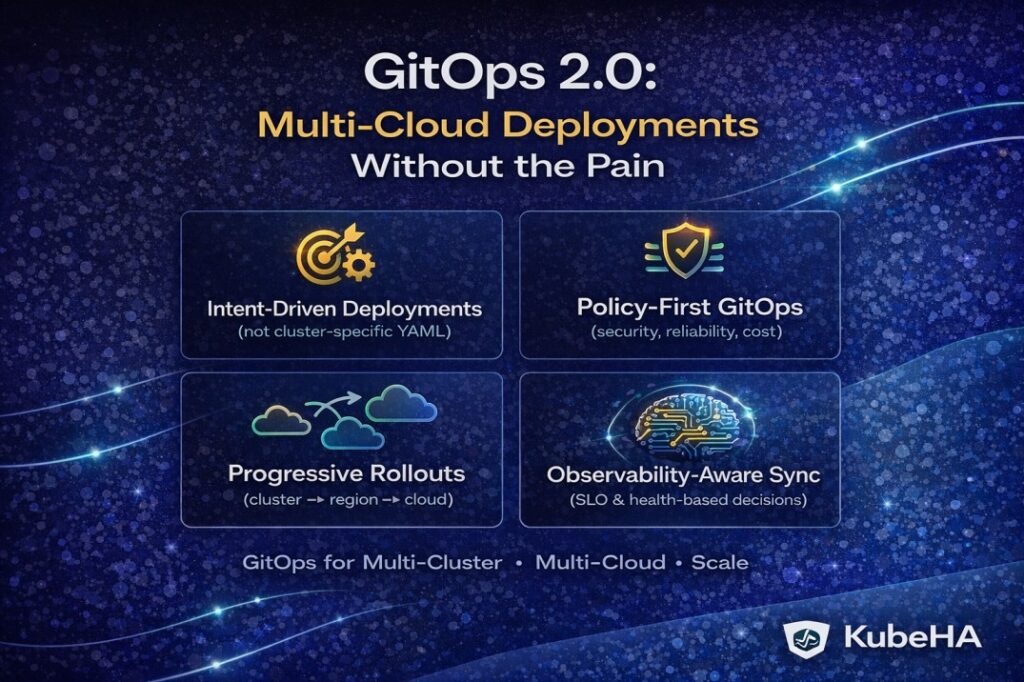
Multi-cluster Kubernetes is the new normal – hybrid, multi-region, and multi-cloud. But keeping thousands of manifests consistent across environments can be chaos.GitOps brings order – using Git as the single source of truth for all clusters. 1. Git as the Control Plane All Kubernetes manifests live in a versioned Git repo. ArgoCD or FluxCD continuously

How GitOps Keeps Multi-Cluster Deployments in Sync Read More »

Disaster Recovery in Multi-Cloud Kubernetes

Downtime is costly – cross-cloud resilience is survival. Disaster Recovery (DR) in multi-cloud Kubernetes ensures workloads stay online even if an entire region or provider fails. Here’s how SREs design it right. 1. Architecture Strategy Active-Active: both clusters handle traffic; use global load balancer (e.g., Cloudflare, Route 53). Active-Passive: secondary cluster on standby; synced via

Disaster Recovery in Multi-Cloud Kubernetes Read More »

Automate Everything – The True DevOps Power

Automation is the backbone of modern DevOps.It’s what converts human processes into reliable, repeatable, and scalable systems – from code commit to production monitoring. 1. Automate Infrastructure Use Terraform, Pulumi, or Crossplane for declarative provisioning. Store infra as code in Git for auditability and rollback. Example: terraform apply -auto-approve Integrate secrets via Vault or Sealed

Automate Everything – The True DevOps Power Read More »

When to Choose Vertical Pod Autoscaling (VPA)

Horizontal scalingadds more pods. Vertical scalinggives existing pods more resources. But when does VPA make sense in production-grade Kubernetes clusters? 1. Ideal Use Cases      Steady workloadswith predictable growth.      Memory-bound apps(e.g., Java, ML models).      Low pod count but high CPU/memory variability.      Non-latency-sensitive workloads (since VPA restarts pods on

When to Choose Vertical Pod Autoscaling (VPA) Read More »

The Support Team’s Secret Weapon – KubeHA AI

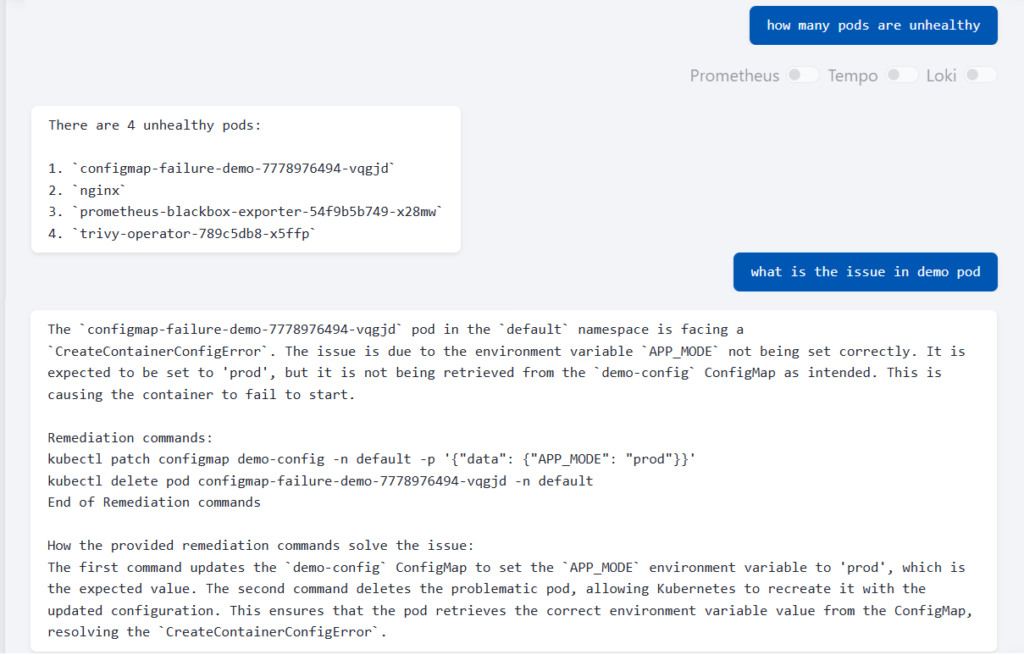
Customer support is the first line of defense when issues arise. But most support engineers aren’t Kubernetes experts. When a pod fails or latency spikes, they often escalate to SREs – slowing down resolution and frustrating customers.KubeHA AI changes that. It gives support teams the same investigative powers as SREs by automatically analyzing logs, metrics,

The Support Team’s Secret Weapon – KubeHA AI Read More »

Chaos Engineering Without Fear

Resilience isn’t proven by uptime – it’s proven by failure. Chaos Engineering is about injecting controlled failures into systems to uncover weaknesses before real outages happen. Done right, it’s not reckless – it’s a scientific way to harden Kubernetes clusters. 1. Start Small with Safe Experiments Always begin in staging clusters before production. Early experiments:

Chaos Engineering Without Fear Read More »

DevOps Best Practices That Still Work in 2025

DevOps has evolved with AI, GitOps, and cloud-native platforms.But some best practices remain timeless — they continue to deliver value for teams in 2025. Infrastructure as Code (IaC) Use Terraform, Pulumi, Helm for repeatable infra deployments. Git is the single source of truth. GitOps for Continuous Delivery Tools like ArgoCD, Flux keep clusters in sync

DevOps Best Practices That Still Work in 2025 Read More »

Scroll to Top