
GitOps solved single-cluster drift.
But in 2026, most teams aren’t running a single cluster anymore.
They’re running multi-cluster, multi-region, multi-cloud Kubernetes-and GitOps had to evolve.
This evolution is what many teams now call GitOps 2.0.
Why GitOps 1.0 Breaks in Multi-Cloud
Classic GitOps worked well when:
- One cluster = one repo
- Same cloud provider
- Uniform networking and IAM
- Small number of environments
In multi-cloud reality, teams hit new pain points:
- Environment drift across clouds
- Cloud-specific manifests leaking into Git
- Hard-coded values per provider
- Manual cluster targeting
- Inconsistent policies and rollout behavior
Git stayed the source of truth-but orchestration logic didn’t scale.
What GitOps 2.0 Actually Means
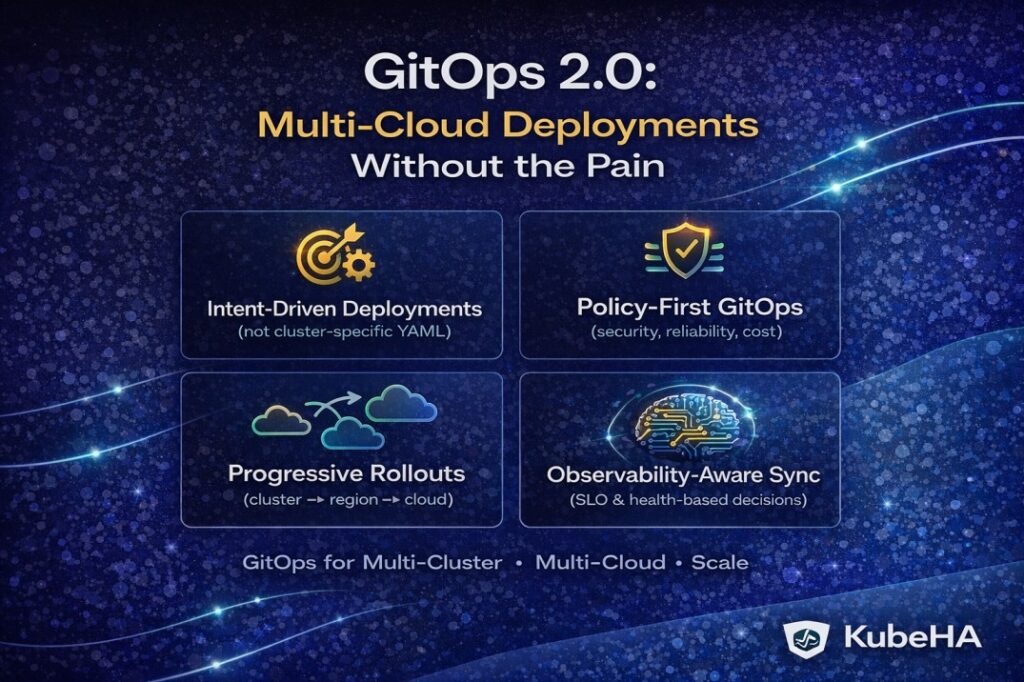
GitOps 2.0 introduces intent-driven deployments, not repo-driven copy-paste.
Key shifts:
- From cluster-specific configs → cluster-agnostic intent
- From manual targeting → dynamic cluster selection
- From static manifests → templated & policy-driven reconciliation
- From sync-only → governance + observability-aware deployments
Git remains the control plane-but smarter.
Core Building Blocks of GitOps 2.0
 ApplicationSets & Fleet Management
Instead of duplicating apps per cluster:
- Use label-based cluster selectors
- Deploy once → reconcile everywhere
- Handle 10s or 100s of clusters safely
This removes environment sprawl.
 Policy-Driven GitOps
GitOps 2.0 integrates Policy as Code:
- Enforce security, reliability, and cost controls
- Prevent unsafe configs before sync
- Apply consistent rules across AWS, GCP, Azure
Policies travel with code-not tribal knowledge.
 Progressive & Multi-Cluster Rollouts
Deployments are no longer “all at once”:
- Canary per cluster
- Region-by-region releases
- Cloud-specific blast radius controls
GitOps becomes release orchestration, not just syncing YAML.
 Observability-Aware Reconciliation
GitOps 1.0 asked: “Did it sync?” GitOps 2.0 asks: “Did it succeed safely?”
Modern platforms integrate:
- SLO checks
- Error budget awareness
- Health-based promotion logic
- Auto-rollback on signal degradation
This is where platforms like KubeHA matter-connecting deployment state with runtime behavior.
 Drift Isn’t Just Config Anymore
GitOps 2.0 detects:
- Runtime drift
- Policy violations
- Cost anomalies
- Unexpected scaling behavior
- Cloud-specific infra inconsistencies
Drift becomes operational, not just declarative.
What This Unlocks for Teams
 Consistent deployments across clouds
Safer multi-region releases
Reduced config duplication
Built-in governance
Faster recovery and rollback
Lower cognitive load for SREs
Multi-cloud stops being fragile-and starts becoming predictable.
 Bottom Line
GitOps didn’t fail. It grew up.
GitOps 2.0 turns Git from a deployment trigger into a multi-cloud control system-one that understands intent, policy, observability, and scale.
If your GitOps workflow feels painful today, you’re likely still running GitOps 1.0.
 Follow KubeHA for:
- Multi-cluster GitOps patterns
- Policy-driven deployments
- Drift detection beyond YAML
- SRE-grade release governance
- AI-assisted deployment analysis
Experience KubeHA today: www.KubeHA.com
KubeHA’s introduction, https://www.youtube.com/watch?v=PyzTQPLGaD0