
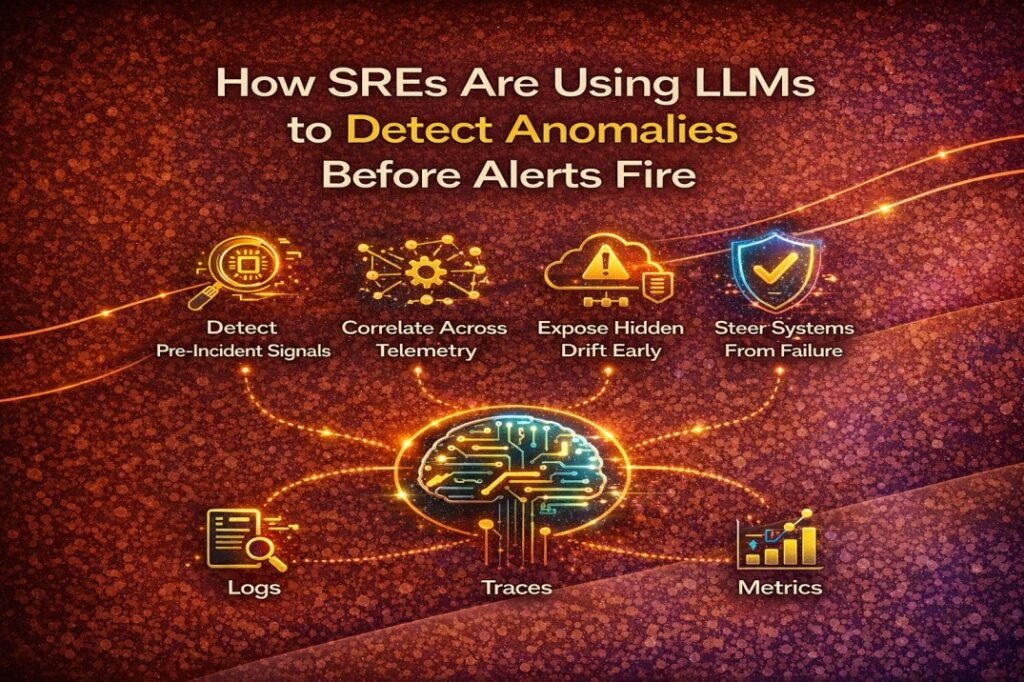
How SREs Are Using LLMs to Detect Anomalies Before Alerts Fire
Traditional alerting is reactive by design.
CPU crosses a threshold.
Latency breaches a limit.
Error rate spikes.
Alert fires only after users are already impacted.
In 2026, advanced SRE teams are moving earlier in the timeline –
using LLMs to detect anomalies before alerts ever trigger.
Why Threshold-Based Alerting Is Too Late
Static alerts struggle because:
- Workloads are highly dynamic
- Traffic patterns change hourly
- Seasonal behavior shifts metrics baselines
- Autoscaling masks early signals
- Microservices amplify small deviations
A metric can be technically “healthy” while the system is already drifting toward failure.
What LLMs Do Differently
LLMs don’t rely on fixed thresholds.
They analyze patterns across signals, such as:
- Metric shape changes (trend, slope, volatility)
- Log semantics (new error phrases, subtle warnings)
- Trace timing shifts (latency distribution skew)
- Event sequences (restarts → throttling → retries)
- Recent config or deployment changes
Instead of asking “Did X exceed Y?”,
LLMs ask “Does this look abnormal compared to system behavior?”
Early Anomaly Signals SREs Care About
Before alerts fire, LLMs can detect:
- Slow resource saturation trends
- Retry storms forming silently
- Latency tail inflation (P95 → P99 shift)
- Memory pressure patterns before OOMKills
- Abnormal pod churn in specific namespaces
- New log patterns never seen before
- Config changes correlated with subtle degradation
These are pre-incident signals, not incidents yet.
The Role of Telemetry Correlation
LLMs become powerful only when they see all signals together:
- Metrics (Prometheus)
- Logs (Loki)
- Traces (Tempo)
- Kubernetes events
- Deployment & config changes
- Scaling and scheduling behavior
This is where platforms like KubeHA matter –
providing correlated telemetry, not siloed data.
LLMs don’t guess.
They reason over evidence already connected.
Real SRE Workflow (Before vs After)
Traditional
- Alert fires
- Scramble to find context
- Manual correlation
- Delayed RCA
LLM-assisted
- Anomaly flagged early
- “This pattern resembles a memory leak + config change”
- Supporting metrics and logs linked
- Preventive action taken
- No alert, no outage
This is incident prevention, not response.
Why This Changes On-Call Life
Early anomaly detection:
- Reduces false positives
- Prevents cascading failures
- Cuts noise during peak hours
- Lowers MTTR by eliminating guesswork
- Reduces alert fatigue dramatically
SREs stop firefighting and start steering systems away from failure.
Common Pitfalls Teams Must Avoid
LLMs fail when teams:
- Feed only metrics without logs/traces
- Skip change data (deploys, config diffs)
- Treat LLM output as truth instead of signal
- Don’t validate against historical behavior
LLMs augment SRE judgment – they don’t replace it.
 Bottom Line
Alerts tell you something is already broken.
LLMs help you see something is about to break.
In modern Kubernetes environments:
- Anomalies appear before alerts
- Correlation matters more than thresholds
- Prevention beats response
The most mature SRE teams in 2026 use LLMs as early-warning systems, not just incident explainers.
 Follow KubeHA for:
- LLM-driven anomaly detection
- Log-metric-trace correlation
- Kubernetes change impact analysis
- AI-assisted SRE workflows
- Practical, production-grade reliability patterns
Follow KubeHA
Experience KubeHA today: www.KubeHA.com
KubeHA’s introduction, https://www.youtube.com/watch?v=PyzTQPLGaD0
#DevOps #sre #monitoring #observability #remediation #Automation #kubeha #IncidentResponse #AlertRecovery #prometheus #opentelemetry #grafana, #loki #tempo #trivy #slack #Efficiency #ITOps #SaaS #ContinuousImprovement #Kubernetes #TechInnovation #StreamlineOperations #ReducedDowntime #Reliability #ScriptingFreedom #MultiPlatform #SystemAvailability #srexperts23 #sredevops #DevOpsAutomation #EfficientOps #OptimizePerformance #Logs #Metrics #Traces #ZeroCode