
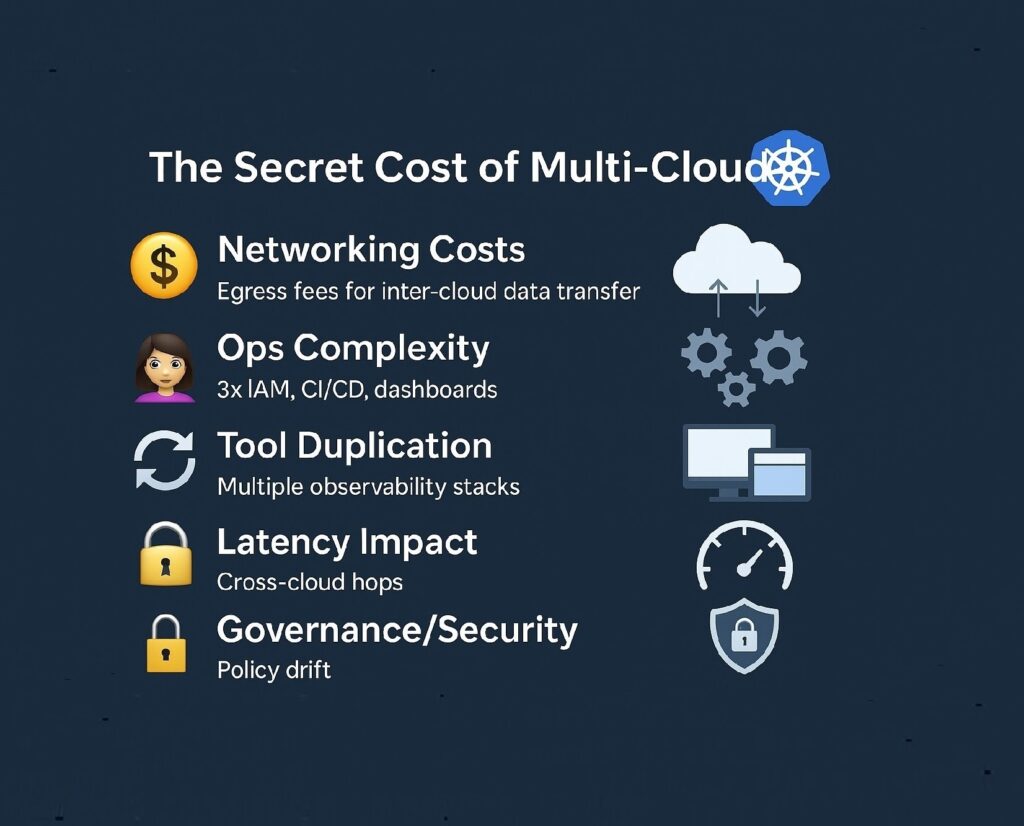
The Secret Cost of Multi-Cloud
 Multi-cloud sounds great on paper: avoid lock-in, maximize resilience, optimize performance.
But here’s the truth every SRE and DevOps engineer eventually discovers → multi-cloud comes with hidden costs that can wreck your budget and operational efficiency.
Let’s break it down.
1. Hidden Networking Costs
- Inter-cloud data transfer is expensive.
- Moving logs, metrics, or ML models between AWS ↔ GCP ↔ Azure racks up egress fees.
- A cross-cloud service mesh (e.g., Istio spanning AWS + GCP) looks elegant — until the bill shows $10k+ in interconnect charges.
 SRE Tip: Keep telemetry local to the cloud where it’s generated. Use federated monitoring (Thanos, Cortex, KubeHA multi-cluster) to aggregate summaries instead of raw data.
2. Operational Complexity = Engineer Cost
- Every provider has different IAM, monitoring APIs, and compliance frameworks.
- Ops teams end up building three of everything: IAM policies, CI/CD pipelines, monitoring dashboards.
- Training engineers across clouds → lost productivity.
SRE Tip: Use Infrastructure as Code (Terraform, Pulumi) with cloud-agnostic modules. Standardize RBAC policies across clusters using OPA Gatekeeper or Kyverno.
3. Tooling & Observability Duplication
- Logs in CloudWatch, metrics in GCP Monitoring, traces in Azure App Insights…
- No single-pane visibility. Alert storms multiply.
- You’re paying 3 vendors for observability, while still blind to cross-cloud dependencies.
SRE Tip: Centralize observability using OpenTelemetry + Prometheus + Loki + Tempo. Feed everything into KubeHA for real-time correlation and RCA across clusters.
4. Latency & SLA Impact
- Cross-cloud API calls add network hops → higher latency, unpredictable reliability.
- SREs chasing latency spikes often find: the bottleneck isn’t code, it’s multi-cloud routing.
SRE Tip: Keep tightly coupled workloads in the same cloud + region. Use multi-cloud only for isolation or DR, not day-to-day dependencies.
5. The Governance & Security Overhead
- Compliance teams must validate policies across 3 clouds.
- Risk of inconsistent encryption, access controls, or key rotation policies.
- A single misconfigured S3 bucket in one cloud → total compliance breach.
SRE Tip: Enforce Zero Trust across all clouds. Automate policy drift detection using OPA + KubeHA.
YAML Example: Federated Multi-Cloud Policy
Using OPA to enforce TLS across all services, no matter the cloud:
apiVersion: constraints.gatekeeper.sh/v1beta1
kind: K8sRequireTLS
metadata:
name: require-tls
spec:
match:
kinds:
– apiGroups: [“”]
kinds: [“Service”]
parameters:
allowedProtocols: [“HTTPS”]
 Bottom line: Multi-cloud isn’t free. Beyond vendor bills, the real cost is in networking, tooling duplication, engineer time, and SLA risk.
With the right strategy — centralized observability, IaC, policy-as-code, and KubeHA automation — multi-cloud becomes manageable without spiraling cost.
Follow KubeHA(https://lnkd.in/gV4Q2d4m)for multi-cloud optimization playbooks, YAML templates, and AI-driven RCA workflows that help SREs cut through the chaos.
Experience KubeHA today: www.KubeHA.com
KubeHA’s introduction, https://lnkd.in/gjK5QD3i(https://lnkd.in/gV4Q2d4m)