
Everyone thinks HPA solves traffic spikes.
It doesn’t.
Here’s the uncomfortable truth:
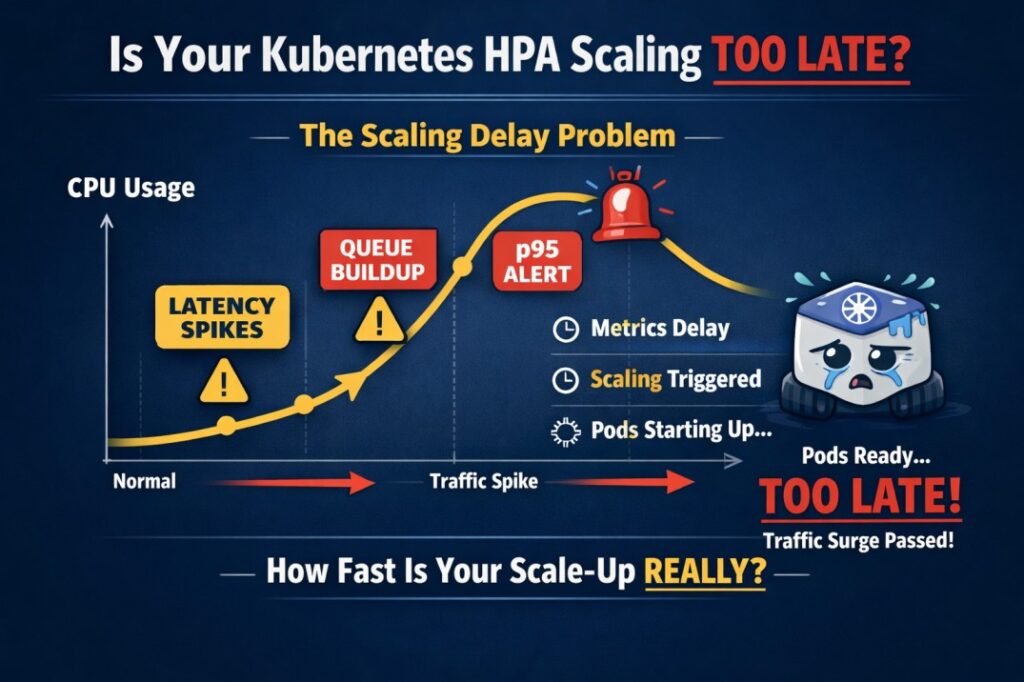
Kubernetes HPA is reactive, not predictive.
By the time CPU hits 80%:
- Your latency is already rising
- Your p95 is exploding
- Queues are forming
- Users are feeling it
Why?
Because HPA:
• Works on averaged metrics
• Depends on scrape intervals
• Responds after saturation begins
• Takes pod startup time into account
👉 So scaling decision = delayed
👉 Pod ready = further delayed
👉 Traffic peak = already passed
That’s why many teams say:
“Autoscaling didn’t help during peak hours.”
Here’s what advanced teams do instead:
✅ Scale on RPS or queue depth
✅ Use custom metrics
✅ Set realistic resource requests
✅ Reduce container cold start time
✅ Use predictive scaling (or buffer pods)
If your scaling only reacts to CPU, you’re already late.
Question for SREs:
How long does your cluster actually take from scale trigger → ready pod?
(If you don’t know – you should.)
Follow KubeHA(https://lnkd.in/gGmRDs77) for deeper insights on cloud-native reliability, cost control, and modern DevOps strategies.
Book a demo today athttps://lnkd.in/dytfT3kk
Experience KubeHA today:www.KubeHA.com
KubeHA’s introduction,https://lnkd.in/gjK5QD3i
#DevOps #sre #monitoring #observability #remediation #Automation #kubeha #IncidentResponse #AlertRecovery #prometheus #opentelemetry #grafana, #loki #tempo #trivy #slack #Efficiency #ITOps #SaaS #ContinuousImprovement #Kubernetes #TechInnovation #StreamlineOperations #ReducedDowntime #Reliability #ScriptingFreedom #MultiPlatform #SystemAvailability #srexperts23 #sredevops #DevOpsAutomation #EfficientOps #OptimizePerformance #Logs #Metrics #Traces #ZeroCode