
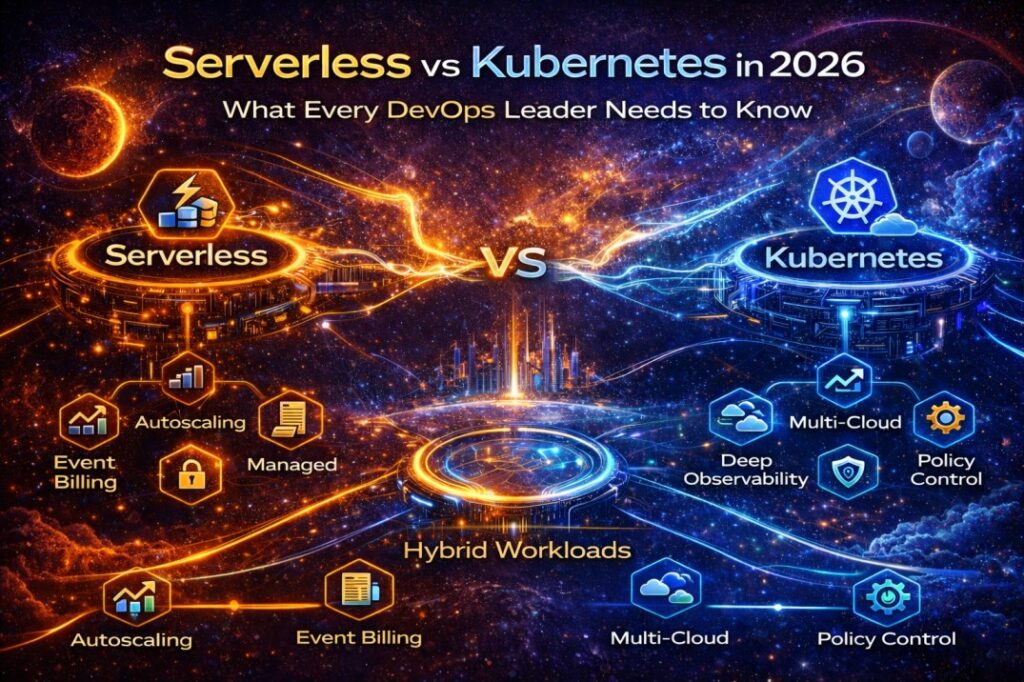
Serverless vs Kubernetes in 2026: What DevOps Leaders Need to Know
The debate isn’t about popularity.
It’s about scale behavior, visibility, and long-term control. Serverless Strengths
• Auto-scaling by default
• Pay-per-execution billing
• Low ops overhead
• Ideal for spiky, event-driven workloads
Challenge:
Cost unpredictability at high throughput, limited runtime control, vendor lock-in risks. Kubernetes Strengths
• Full control over runtime & scaling
• Predictable cost at steady load
• Multi-cloud portability
• Deep observability integration
Challenge:
Higher operational complexity, requires SRE maturity. At Enterprise Scale (2026 Reality)
Serverless works best for:
 Event pipelines
Async processing
Edge workloads
Kubernetes wins for:
Sustained traffic systems
Latency-sensitive apps
Platform engineering models
Advanced observability & policy control The Real Answer?
Most enterprises use both strategically:
Serverless at the edge.
Kubernetes at the core.
Unified telemetry across both.
The winners aren’t picking sides.
They’re architecting intentionally.
Follow KubeHA(https://lnkd.in/gGmRDs77) for deeper insights on cloud-native reliability, cost control, and modern DevOps strategies.
Book a demo today athttps://lnkd.in/dytfT3kk
Experience KubeHA today:www.KubeHA.com
KubeHA’s introduction,https://lnkd.in/gjK5QD3i
#DevOps #sre #monitoring #observability #remediation #Automation #kubeha #IncidentResponse #AlertRecovery #prometheus #opentelemetry #grafana, #loki #tempo #trivy #slack #Efficiency #ITOps #SaaS #ContinuousImprovement #Kubernetes #TechInnovation #StreamlineOperations #ReducedDowntime #Reliability #ScriptingFreedom #MultiPlatform #SystemAvailability #srexperts23 #sredevops #DevOpsAutomation #EfficientOps #OptimizePerformance #Logs #Metrics #Traces #ZeroCode