
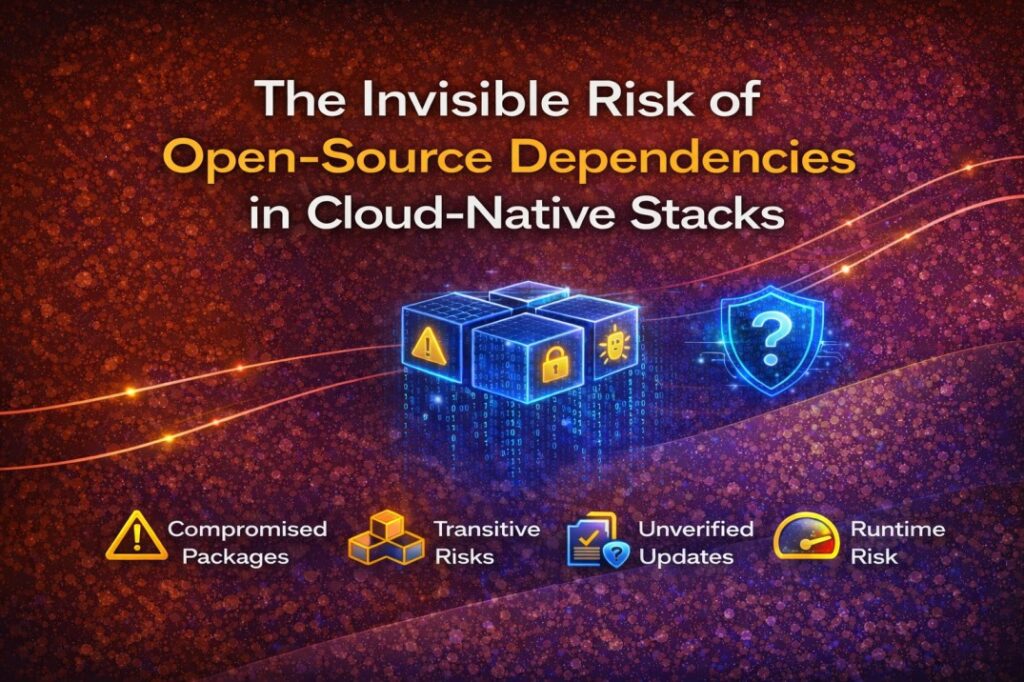
Cloud-native platforms run on open source.
Linux, Kubernetes, Envoy, Prometheus, OpenTelemetry, Helm charts, language runtimes, client libraries – your production stack is a supply chain, not a single application.
And most of the risk is invisible.
Why Open-Source Risk Is Hard to See
Open-source dependencies are:
- Deeply nested (dependencies of dependencies)
- Pulled automatically during builds
- Updated indirectly via base images or charts
- Shared across teams and clusters
- Often trusted without verification
By the time a vulnerability surfaces, it may already be:
- In production
- Deployed across clusters
- Embedded inside container images
- Included in multiple services
This is supply chain risk, not just CVEs.
The Real Threat Isn’t Just “Critical CVEs”
Modern incidents increasingly involve:
- Compromised transitive dependencies
- Malicious package injections
- Typosquatting attacks
- Signed but vulnerable artifacts
- Unmaintained libraries with no fixes
- Over-permissive defaults in OSS charts
Many of these never trigger traditional vulnerability scanners early enough.
Why Cloud-Native Makes This Worse
Cloud-native accelerates everything:
- Faster CI/CD pipelines
- Automated image builds
- Helm and operators pulling external code
- GitOps syncing changes instantly
- Ephemeral workloads hiding compromised artifacts
Speed magnifies blast radius.
Where Traditional Controls Fall Short
Most teams rely on:
- Periodic image scans
- Static SBOM reports
- Manual review of Helm charts
- Post-deployment alerts
These controls are:
- Reactive
- Disconnected from runtime behavior
- Blind to “what changed before impact”
Security without context ≠ security.
What Modern Dependency Risk Management Looks Like
In 2026, mature teams combine:
- SBOMs as first-class artifacts
- Signature and provenance verification (SLSA, Sigstore)
- Policy-as-Code enforcement in CI/CD
- Runtime validation (was this dependency actually used?)
- Continuous drift detection across clusters
Security shifts from scanning to continuous verification.
Why Observability Matters for Dependency Risk
Not every vulnerable dependency is exploitable.
The real questions are:
- Is this code path exercised?
- Did behavior change after an update?
- Did latency, errors, or resource usage shift?
- Did a config or dependency update precede the incident?
This is where observability meets security.
Platforms like KubeHA help by correlating:
- Dependency and config changes
- Runtime metrics and logs
- Traces showing execution paths
- Kubernetes events and deployments
Security findings gain operational context.
Common Mistakes Teams Still Make
Even advanced teams struggle when they:
- Trust OSS implicitly without verification
- Ignore transitive dependencies
- Treat SBOMs as compliance paperwork
- Scan images but ignore runtime signals
- Lack visibility into change → impact relationships
Dependency risk isn’t static – it evolves with your system.
 Bottom Line
Open source powers cloud-native innovation –
but unobserved open source powers cloud-native incidents.
In modern Kubernetes environments:
- Dependencies are code
- Code changes behavior
- Behavior creates risk
If you don’t connect dependencies, changes, and runtime signals, the most dangerous risks remain invisible.
 Follow KubeHA for insights on:
- Cloud-native supply chain risk
- Kubernetes security + observability correlation
- Dependency change impact analysis
- AI-assisted incident prevention
- Production-grade reliability and security intelligence
Follow KubeHA
Experience KubeHA today: www.KubeHA.com
KubeHA’s introduction, https://www.youtube.com/watch?v=PyzTQPLGaD0
#DevOps #sre #monitoring #observability #remediation #Automation #kubeha #IncidentResponse #AlertRecovery #prometheus #opentelemetry #grafana, #loki #tempo #trivy #slack #Efficiency #ITOps #SaaS #ContinuousImprovement #Kubernetes #TechInnovation #StreamlineOperations #ReducedDowntime #Reliability #ScriptingFreedom #MultiPlatform #SystemAvailability #srexperts23 #sredevops #DevOpsAutomation #EfficientOps #OptimizePerformance #Logs #Metrics #Traces #ZeroCode